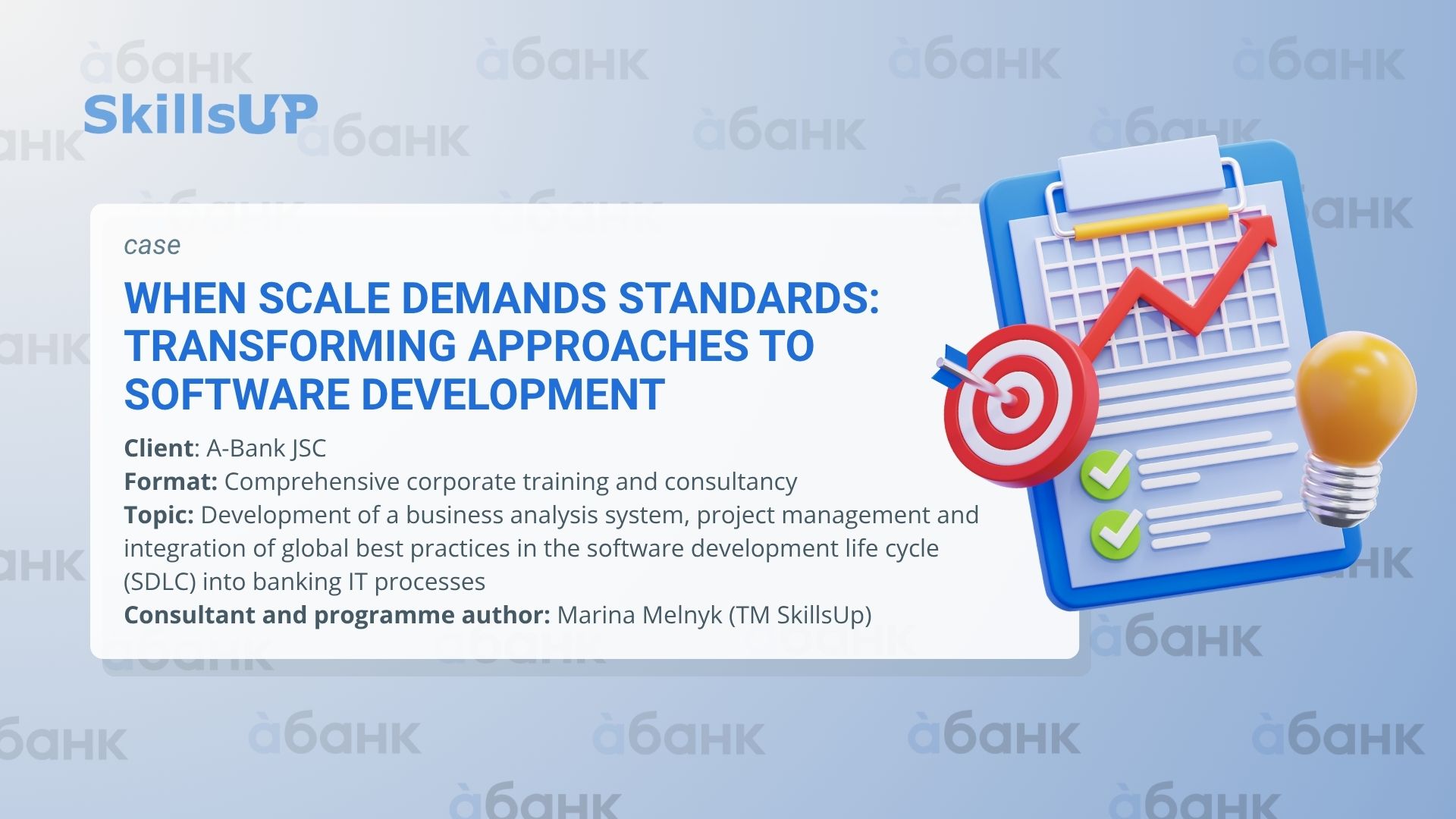
Client: JSC "A-Bank"
Format: Comprehensive corporate training and consulting
Topic: Development of business analysis and project management systems, and integration of the best global SDLC practices into banking IT processes
Consultant and program author: Maryna Melnyk (TM SkillsUp).
Context
The modern financial sector demands unprecedented speed of adaptation, flexibility, and continuous implementation of innovations from banks. JSC "A-Bank" is one of the undisputed leaders in the Ukrainian banking market, known for its focus on high-quality customer service and advanced technological solutions. However, with the continuous expansion of the scale and complexity of IT projects, as well as the involvement of a large number of specialists, there is a critical need to improve and strictly standardize internal software development processes.
Objectives
To achieve the bank's strategic goals, the following pool of objectives was formed:
- SDLC Synchronization: Synchronize the understanding of the software development life cycle among all members of the project teams — from the idea inception stage to implementation and support.
- Methodological Framework: Form a unified methodological framework for eliciting, analyzing, documenting, and continuously managing requirements.
- Global Standards: Master and implement modern global standards, frameworks, and management methodologies (Waterfall, Agile, Scrum, Kanban, PRINCE2, Lean, etc.).
- Effective Communication: Develop skills for effective business communication, targeted stakeholder management, and conflict resolution in cross-functional teams.
- Visual Modeling: Teach teams to use modern visual modeling tools (UML, BPMN) for transparent architecture design and business process optimization.
- Product Mindset: Implement a product-oriented approach to create solutions that maximize business value and customer satisfaction.
Solution
In response to the bank's complex request, the SkillsUp team led by Maryna Melnyk developed and implemented a large-scale 27-module training and consulting program, "Diving into Project Management and Business Analysis." The program was distinguished by a deep immersion into the specifics and was based on a premium, systematic approach to learning, where each module was a logical continuation of the previous one and was practiced on real practical cases. The focus of the work included:
- 1. Fundamentals of the Life Cycle and Project Management. The foundation of the transformation was an in-depth study of SDLC. Teams analyzed the three main stages in detail: Inception, Development, and Run. The concepts of project, product, and process were clearly differentiated; various business contexts, company types, and cooperation models were explored. Special attention was paid to identifying key artifacts at each stage.
- 2. Models, Methodologies, and Development Frameworks. To ensure flexibility and efficiency of development, participants studied traditional models (Waterfall, V-Model), iterative and spiral models, agile methodologies (Agile, Extreme Programming, Lean, Kanban), as well as comprehensive management frameworks (Scrum, RUP, PRINCE2, SAFe).
- 3. Effective Communication and Stakeholder Management. Participants underwent deep training on communication, empathetic listening, dealing with aggression, and turning conflicts into a constructive direction. For stakeholder management, tools were introduced: "Power/Interest" matrix, "Onion" diagram, and heat maps.
- 4. Deep Business Analysis and Requirements Architecture. Participants learned to distinguish between business requirements, user requirements, and system requirements. Techniques such as Porter's 5 Forces, PEST, and SWOT were applied. The requirements elicitation process was carried out through brainstorming sessions and in-depth interviews. Documentation formats included Use Cases, User Stories, SRS, and Acceptance Criteria.
- 5. Visual Modeling, BPMN, and UML. Teams implemented visual modeling practices. BPMN notation allowed for the graphical description of complex banking processes, while UML became the standard for describing architecture, eliminating ambiguities during implementation.
- 6. Product Mindset, UX, and Risk Management. Specialists learned to build a Unique Value Proposition (UVP), create Product Roadmaps, and Customer Journey Maps (CJM). A separate module on UX/Usability taught how to design intuitively understandable interfaces. Additionally, teams mastered a systematic risk management process.
Results
The implementation of this fundamental program allowed A-Bank's IT department to reach a qualitatively new level of operational efficiency:
- Unified Conceptual Framework: A unified conceptual framework was formed, and the software development life cycle processes were standardized across all teams.
- Quality of Requirements: The quality of gathering and documenting requirements was significantly improved, minimizing the risks of costly reworks at later stages.
- Transparent Business Processes: Modern visual modeling practices (BPMN, UML) were introduced, making business processes transparent and understandable.
- Managerial Competencies: Managers and analysts strengthened their managerial competencies, stakeholder management skills, and ability to conduct complex negotiations.
- Maximum Value: The integration of a product mindset allowed focusing development on creating maximum value for the end consumer.
Client Feedback
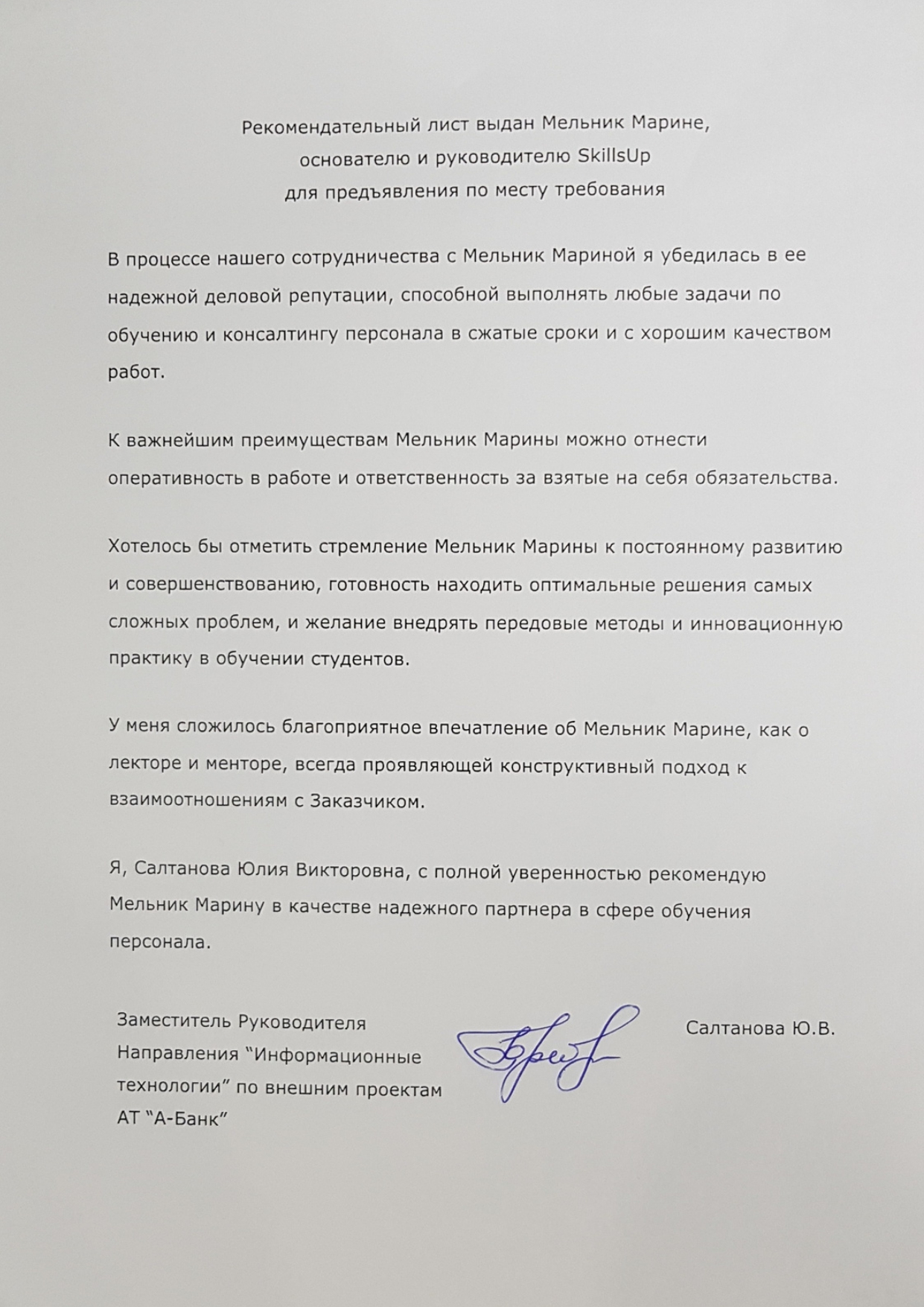
The high effectiveness of the program is confirmed by the official feedback from the management of JSC "A-Bank".